Lead Retrieval Should Be a Workflow System, Not a Badge Scanner
Why lead retrieval should preserve conversation context, support decisions, and carry every event interaction into the next meaningful action.
By Ali KamyabCo-founder & CPO, SignalThread6-minute read
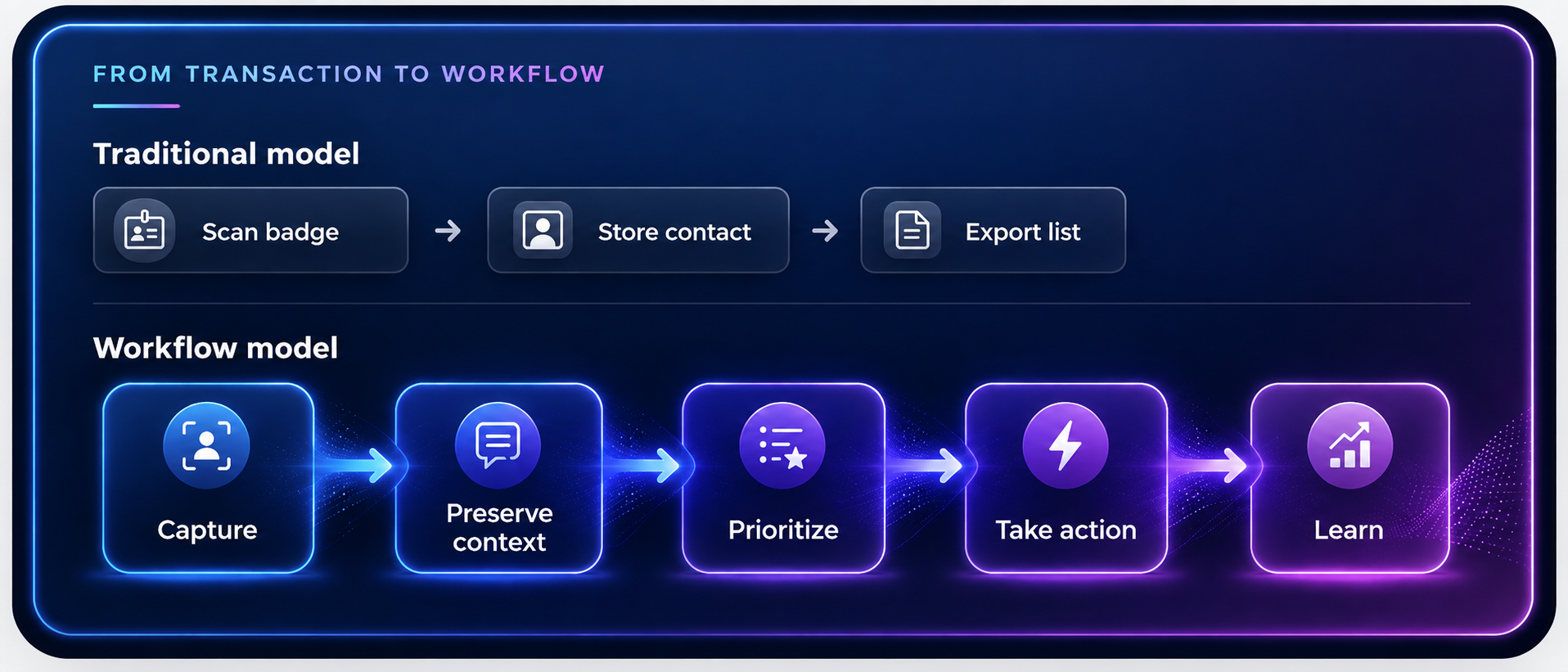
For years, lead retrieval has been treated as a capture problem: scan the badge, create the contact record, export the list, and send it somewhere else.
That workflow is familiar, but it is no longer enough.
SignalThread's perspective is that lead retrieval should preserve the conversation and carry its context into the next meaningful action.
The real value of an event conversation lives in everything around the scan: what the person cared about, which problem they were trying to solve, how urgent it felt, what the representative promised, and what should happen next.
A capture-only lead retrieval workflow records the person while losing the conversation.
Lead retrieval optimized the badge scan, not the moment after it
Badge scanning should be fast, dependable, and easy to use in a crowded booth. But it is also the most straightforward part of lead retrieval.
The harder work begins immediately afterward. A representative has to remember the conversation, decide whether the lead matters, preserve useful details, identify a next action, and communicate enough context to whoever owns the follow-up.
At a busy event, that process is repeated dozens or hundreds of times. Notes get shorter. Details disappear. Follow-up decisions wait until the team is back home trying to reconstruct the event from incomplete records.
A contact record is not conversation intelligence
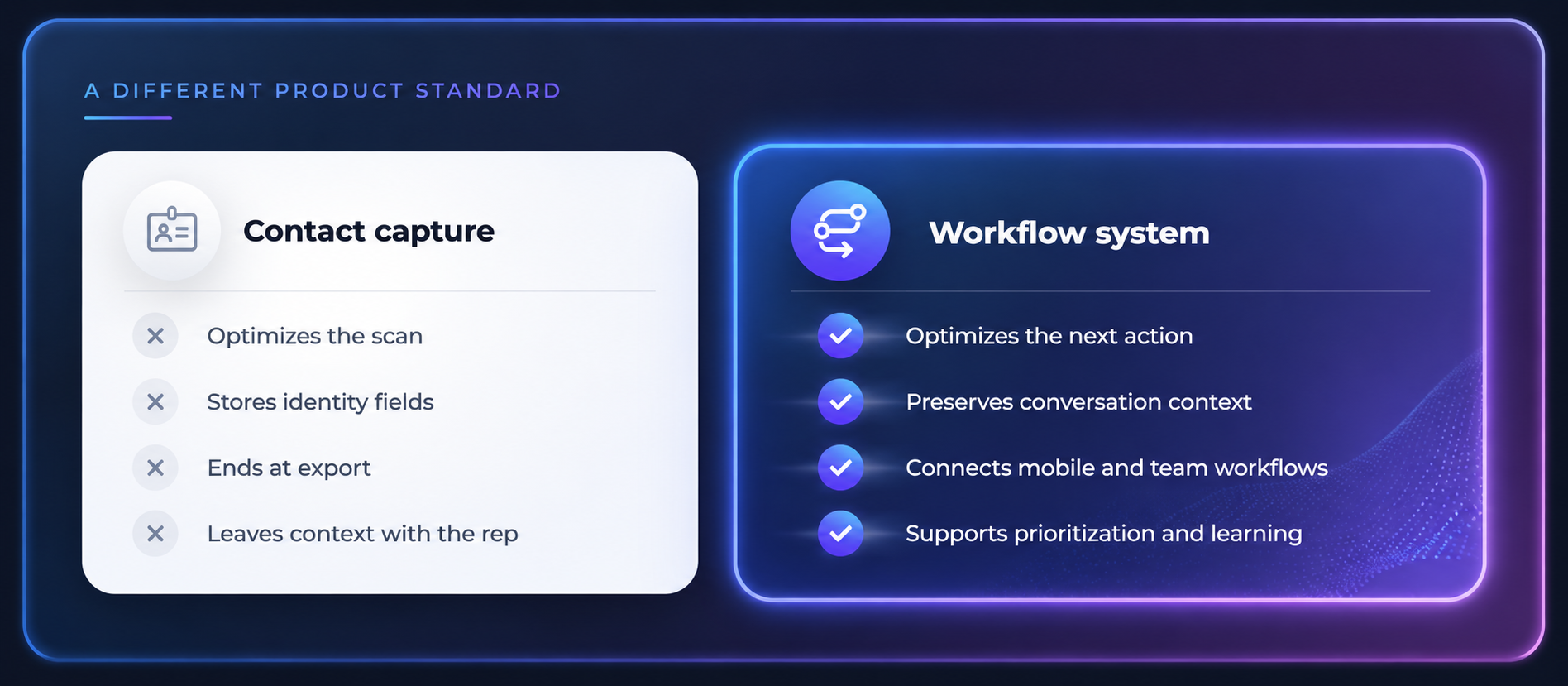
A standard scan may provide a name, company, title, email address, and phone number. Those fields identify the person. They do not explain the opportunity.
They do not tell the next person why the attendee stopped, what caught their attention, whether they were researching or actively evaluating, who else is involved, or what the representative committed to sending.
That distinction matters because good follow-up should continue the conversation. “Great meeting you at the event” only proves that a scan occurred.
The product should reduce cognitive load
Traditional lead retrieval often asks booth representatives to behave like data-entry operators. Scan the lead. Navigate through fields. Type notes. Choose categories. Assign a score. Create a reminder.
Every extra step competes with the representative’s actual job: having a useful conversation.
A modern product should make context capture feel natural, keep the field experience fast, and help the team understand what deserves attention while the event is still happening. The goal is not to collect more data. It is to reduce the thinking, remembering, sorting, and reconstructing required from the people using the system.
The architecture has to support the promise
It is tempting to treat this as a user-interface problem: add a notes field, a score, and a follow-up button. But a connected product experience requires a connected system underneath it.
The mobile experience, administrative workspace, and downstream integrations need to operate from a consistent lead record and a shared understanding of what happened. Otherwise, context becomes duplicated, stale, or lost between systems.
The mobile product must remain dependable in an unforgiving environment: inconsistent connectivity, distracted users, limited time, and constant movement. Prioritization rules should not change from screen to screen. Integrations should extend the workflow rather than create another copy of the contact. Automation should be traceable and grounded in captured context.
The best architecture is not the architecture users notice. It is the architecture that allows the experience to feel simple and reliable as the system becomes more capable.
Intelligence should support decisions
There is a great deal of attention on using artificial intelligence to write follow-up emails. That can be useful, but writing is not the first decision the workflow needs to make.
The system should first understand whether the lead matters, why it matters, what the person cared about, who should own the next step, and how quickly the team should respond.
But it should not stop at presenting that analysis back to the team. It should turn the conversation into an executable next step: prioritize the lead, route it to the right owner, recommend the timing, prepare the follow-up, surface the right collateral, create the meeting path, and carry the context into the systems where the team already works.
That is the difference between intelligence that describes work and intelligence that actually moves work forward.
Generating polished language without reliable context only creates more polished generic outreach. The intelligence layer should begin with understanding, make the decision, and then help execute the action—with the team remaining in control.
The future is not more fields
The next generation of lead retrieval will not win by adding more form fields to the scan screen. It will win by designing a better workflow around the conversation.
The product should move teams beyond “Who did we scan?” and even beyond “What did we learn, what matters most, and what should we do next?”
The stronger standard is: the system already understands the conversation, has identified the next best action, and is ready to carry it forward.
That could mean routing the lead, preparing a personalized message, scheduling the next conversation, sending the promised material, updating the CRM, or triggering a coordinated follow-up workflow. The team should review and control the action—not rebuild it from scratch.
The badge scan will remain part of lead retrieval. It just should not define the category. The category should be defined by how effectively the system turns an event conversation into action.
Continue the Lead Retrieval path
Move from category design to practical decisions and proof.
- See the SignalThread Lead Retrieval product workflow
- Use the Complete Guide to Event Lead Retrieval for the full operating model
- The Follow Up Should Start Before the Event Ends
- Case proof: From badge scans to buyer signals: why Colleen's team chose SignalThread over the default event lead retrieval tool
- Case proof: The lead isn't the badge. It's the conversation.